Bouc-Wen#
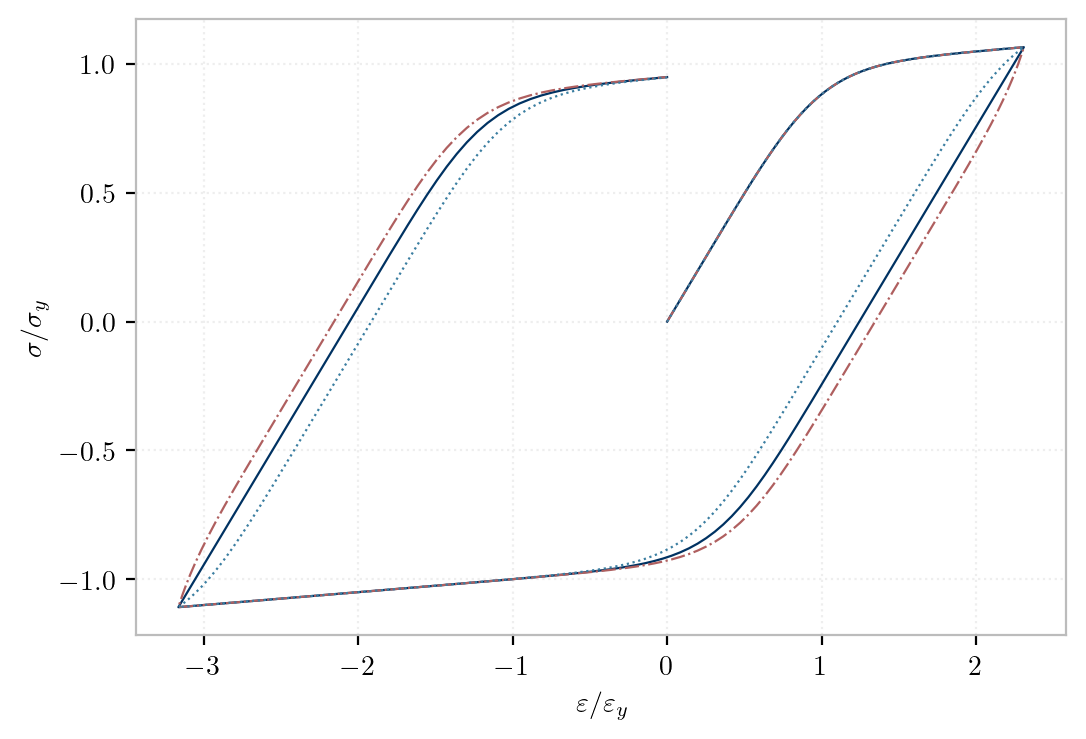
- xara.UniaxialMaterial("BWBF", E, Fy, alpha, n, **options)
Construct a uniaxial Bouc-Wen material with optional pinching and degradation.
- Parameters:
- E: float
initial stiffness, \(E_0\) [1]
- Fy: float
yield force, \(F_y\) [1]
- alpha: float
ratio of post-yield stiffness to the initial elastic stiffenss, \(0 \leq \alpha \leq 1\) [1]
- n: float
sharpness of yield, \(n\) [1]
- beta: float, optional
hysteretic hardening shape parameter \(\beta\), defaults to \(\beta=0.5\) [1]
- strength_rate: float
strength degradation rate, \(\delta_{\nu}\)
- stiffness_rate: float
stiffness degradation rate, \(\delta_{\eta}\)
- Pinching:
- pinch_slope: float
pinching slope, \(p\)
- pinch_start: float
pinching initiation, \(q\)
- pinch_slip: float
measure of total slip, \(\zeta\)
- pinch_rate: float
pinching rate, \(\delta_{\psi}\)
- pinch_size: float
pinching magnitude, \(\psi_0\)
- lamda: float
pinching severity, \(\lambda\)
- General:
- density: float
density. Units of density. See Mass Sources. Added in 0.1.29
Parameters#
- class BoucWen#
- E: float#
Initial stiffness \(E\)
- Fy: float#
Yield stress of the hysteretic curve \(F_y\). Analogous to
Steel02.Fy.
- beta: float = 0.5#
Hysteretic shape parameter \(\beta\).
- pinch_slope: float = 0.0#
Optional pinching parameter \(p\) introduced by Baber and Noori (1986).
- pinch_start: float = 0.0#
Optional pinching parameter \(q\) introduced by Foliente (1995). When \(q = 0\) the pinching formulation of Baber and Noori (1986) is recovered.
Theory#
A Bouc-Wen uniaxial material defines a scalar relation between a stress \(\sigma\) and strain \(\varepsilon\) in the form:
where \(z\) is an internal history variable governed by an ordinary differential equation.
This material model is an extension of the original Bouc-Wen model that includes pinching (Baber and Noori (1986) and Foliente (1995)).
When parameterized with \(F_y\), the additional constraint \(\beta+\gamma=1\) is introduced to assure \(F_y\) as the yield strength of the structure.
Parameter |
Description |
|---|---|
\(E \geq 0\) |
Initial stiffness |
\(F_y\) |
Yield point |
\(\alpha\) |
Post-yield stiffness ratio |
\(\beta\) |
Basic hysteretic shape control |
\(n\) |
Sharpness of yield |
Parameter \(\gamma\) is usually in the range from -1 to 1 and parameter \(\beta\) is usually in the range from 0 to 1.
The hysteresis loop will exhibit softening for the following cases:
\(\beta + \gamma \gt 0\) and \(\beta - \gamma \gt 0\),
\(\beta + \gamma \gt 0\) and \(\beta - \gamma \lt 0\), and
\(\beta + \gamma \gt 0\) and \(\beta - \gamma = 0\).
The hysteresis loop will exhibit hardening if \(\beta + \gamma \lt 0\) and \(\beta - \gamma \gt 0\),
quasi-linearity is exhibited if \(\beta + \gamma = 0\) and \(\beta - \gamma \gt 0\).
Degradation#
The parameters that control degradation are:
Parameter |
Description |
Bounds |
|---|---|---|
\(\delta_{\nu} \geq 0\) |
Strength degradation rate |
\(0 \leq \delta_v \leq 0.36\) |
\(\delta_{\eta} \geq 0\) |
Stiffness degradation rate |
\(0 \leq \delta_\eta \leq 0.39\) |
Pinching#
The following parameters control pinching in the model:
Parameter |
Description |
Bounds |
|---|---|---|
\(\zeta_0\) |
Measure of total slip |
\(0 \leq \zeta_0 \leq 1\) |
\(p\) |
Pinching slope |
\(0 \leq p \leq 1.38\) |
\(q\) |
Pinching initiation |
\(0.01 \leq q \leq 0.43\) |
\(\psi\) |
Pinching magnitude |
\(0.1 \leq \psi \leq 0.85\) |
\(\delta_\psi\) |
Pinching rate |
\(0 \leq \delta_\psi \leq 0.09\) |
\(\lambda\) |
Pinching severity |
\(0.01 \leq \lambda \leq 0.8\) |
\(c_{\varepsilon}\) |
Hysteretic energy amplification factor |
\(50 \leq c_{\varepsilon} \leq 500\) |
\(c_h\) |
Crack closure coefficient |
\(0.01 \leq c_h \leq 1.5\) |
\(\delta_\nu, \delta_\psi\), and \(\lambda\) are rather insensitive parameters.
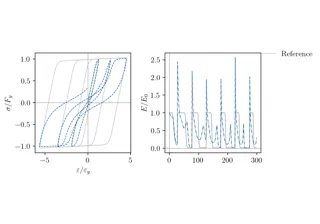
Examples#
OpenSees Compatibility#
This material superceeds the following materials, which are supported for legacy purposes:
Bouc-Wen-Baber, written by Terje Haukaas and described by Haukaas and Der Kiureghian (2003).
uniaxialMaterial BoucWen $tag $b $E $n $gamma $beta $Ao \
                         $delta_a $delta_v $delta_n
Note that this version does not expose an \(F_y\) parameter.
Bouc-Wen without pinching or degradation, implemented by A. Schellenberg.
uniaxialMaterial BoucWenOriginal tag E? Fy? alphaL? < alphaNL? mu? n? beta? gamma? >
In order to capture hardening effects that may occur in various hysteretic systems, this material appends a Duffing-like nonlinear term to the stress, parameterized by the exponent \(\mu\):
where
An example with \(\beta = \gamma = 0.5\), \(\mu = 2\), \(n = 1\):
uniaxialMaterial BoucWenOriginal 1 $E $Fy $alphaL $alphaNL 2.0 1.0 0.5 0.5
References:
Hybrid Simulation of Seismic Isolation Systems Applied to an APR-1400 Nuclear Power Plant
Bouc-Wen with Foliente pinching, but no degradation. Implemented by Raquib Hossain
uniaxialMaterial BWBN tag \
                 alpha E n $gamma $beta $Ao \
                 $q $zetas $p $Shi $deltaShi $lambda $tol $maxIter
Raquib Hossain, The University of Queensland (UQ), Australia and Bangladesh University of Engineering and Technology (BUET)
See this page.
References#
Kim, Taeyong, Oh‐Sung Kwon, and Junho Song. “Deep Learning Based Seismic Response Prediction of Hysteretic Systems Having Degradation and Pinching.” Earthquake Engineering & Structural Dynamics 52, no. 8 (July 2023): 2384–2406. doi: 10.1002/eqe.3796.
Oh, Sebin, Taeyong Kim, and Junho Song. “Bouc–Wen Class Models Considering Hysteresis Mechanism of RC Columns in Nonlinear Dynamic Analysis.” International Journal of Non-Linear Mechanics 148 (January 2023): 104263. doi: 10.1016/j.ijnonlinmec.2022.104263.
Oh, Sebin “Hysteresis Modeling Framework Using Bouc-Wen Model Considering Cracking Effects” link
Bouc–Wen class models considering hysteresis mechanism of RC columns in nonlinear dynamic analysis doi: 10.1016/j.ijnonlinmec.2022.104263
Haukaas, T. and Der Kiureghian, A. (2003). “Finite element reliability and sensitivity methods for performance-based earthquake engineering.” REER report, PEER-2003/14 link.
Baber, T. T. and Noori, M. N. (1985). “Random vibration of degrading, pinching systems.” Journal of Engineering Mechanics, 111(8), 1010-1026.
Bouc, R. (1971). “Mathematical model for hysteresis.” Report to the Centre de Recherches Physiques, pp16-25, Marseille, France.
Wen, Y.-K. (1976). Method for random vibration of hysteretic systems.” Journal of Engineering Mechanics Division, 102(EM2), 249-263.
Baber, T. T., & Noori, M. N. (1986). “Modeling general hysteresis behavior and random vibration application.” Journal of Vibration Acoustics Stress and Reliability in Design, 108, 411.
Foliente, G. C. (1995). Hysteresis modeling of wood joints and structural systems. Journal of Structural Engineering, 121(6), 1013-1022.
Hossain, M. R., Ashraf, M., & Padgett, J. E. (2013). “Risk-based seismic performance assessment of Yielding Shear Panel Device.” Engineering Structures, 56, 1570-1579. doi
Hossain, M. R., & Ashraf, M. (2012). “Mathematical modelling of yielding shear panel device.” Thin-Walled Structures, 59, 153-161. doi