Inelastic Shear Link (Shells)#
Download notebookThis example models the shear link from Steel Shear Link using shell elements.
Modeling#
import veux
import xara
from xara.helpers import find_nodes, find_node
from xsection.library import from_aisc

import matplotlib.pyplot as plt
Create the xara.MultiaxialMaterial using the PlasticJ2 formulation:
import xara.units.iks as units

Fy = 35.0*units.ksi
E  = 30e3*units.ksi
G  = 12e3*units.ksi
poisson = 0.25

material = xara.MultiaxialMaterial(
    E  = E,
    G  = G,
    Fy = Fy,
    Hkin = 0.002 * E,
    Hiso = 0.002 * E,
    type="PlasticJ2" #"J2PlateFibre"#
)

shape = from_aisc("W18x40",
                    units=units,
                    mesh_scale=1/2,
                    material=material,
                    fillet=True)
def create_model(L, d, b, tw, tf):
    """
    Create a shell model of a wide-flange beam with the given dimensions and length.
    """
    # create Model with three-dimensions and 6 DOF/node
    model = xara.Model(ndm=3, ndf=6)
    order = 1
    element = "ShellMITC4"  #"ASDShellQ4" #"ShellMITC9"# "ShellNLDKGQ" #,  #
    flags = ()


    # Define sections
    # -----------------
    nip = 5
    model.material(material)
    model.section("LayeredShell", 1, nip,
                    1, tw/nip,
                    1, tw/nip,
                    1, tw/nip,
                    1, tw/nip,
                    1, tw/nip)
    model.section("LayeredShell", 2, nip,
                    1, tf/nip,
                    1, tf/nip,
                    1, tf/nip,
                    1, tf/nip,
                    1, tf/nip)

    # Define geometry
    # ---------------
    # these should both be even
    nx = 25 # 200
    ny = 4 # 4
    nz = 8


    # Flanges
    model.surface((nx, ny),
                  order=order,
                  element=element,
                  args=("-section", 2, *flags),
                  points={
                      1: [ 0, -b/2, d/2],
                      2: [ L, -b/2, d/2],
                      3: [ L,  b/2, d/2],
                      4: [ 0,  b/2, d/2],
                  })

    model.surface((nx, ny),
                  order=order,
                  element=element,
                  args=("-section", 2, *flags),
                  points={
                      1: [ 0, -b/2, -d/2],
                      2: [ L, -b/2, -d/2],
                      3: [ L,  b/2, -d/2],
                      4: [ 0,  b/2, -d/2],
                  })

    # Web
    model.surface((nx, nz),
                  order=order,
                  element=element,
                  args=("-section", 1, *flags),
                  points={
                      1: [ 0,  0,  d/2],
                      2: [ L,  0,  d/2],
                      3: [ L,  0, -d/2],
                      4: [ 0,  0, -d/2],
                  })

    return model
L = 28*units.inch

model = create_model(
    L=L,
    b=shape.bf,
    d=shape.d,
    tw=shape.tw,
    tf=shape.tf)


for node in find_nodes(model, x=0):
    model.fix(node, (1,1,1, 1,1,1))

#
for node in find_nodes(model, x=L):
    model.fix(node, (1,1,0, 1,1,1))


artist = veux.create_artist(model, vertical=3)
artist.draw_surfaces()
artist.draw_outlines()
artist
Analysis#
import time

Verbose = False
if Verbose:
    Progress = lambda *args, **kwds: None
else:
    from tqdm import tqdm as Progress
nstep = 300
Uult = 0.5
dU   = Uult/nstep
dPmx = dU
dPmn = dU/100
siter = 2

# Find the control node
tip = find_node(model, x=L,y=0,z=shape.d/2)


#
# Perform the analysis
#
model.numberer("Plain")
model.system('Umfpack02')
model.constraints("Transformation")
model.test("Energy", 1e-18, 20, 0)

model.timeSeries("Path", 1,
                    values=[0,  Uult, -Uult, 0.0],
                    time=  [0,   1,       4,   5])

model.pattern("Plain", 1, 1)
for node in find_nodes(model, x=L):
    model.sp(node, 3, 1.0, pattern=1)


model.integrator("LoadControl", dU)
model.analysis("Static")

pbar = Progress(total=100, unit="%")

tstart = time.time()

ux = []
uy = []
uz = []
P  = []
end_nodes = list(find_nodes(model, x=L))

while model.state.time < 5.0:
    if model.analyze(1) != 0:
        break

    if pbar is not None:
        pbar.update(int(100*model.state.time//5) - pbar.n)
        pbar.set_postfix(iter=model.numIter())
    ux.append(model.nodeDisp(tip, 1))
    uy.append(model.nodeDisp(tip, 2))
    uz.append(model.nodeDisp(tip, 3))

    # Compute the reaction at the end
    model.reactions()
    P.append( sum(model.nodeReaction(node, 3) for node in end_nodes))

tend = time.time()
print(f"Analysis took {tend - tstart} seconds")
100%|██████████| 100/100 [03:16<00:00, 1.87s/%, iter=1]
Analysis took 196.87268590927124 seconds
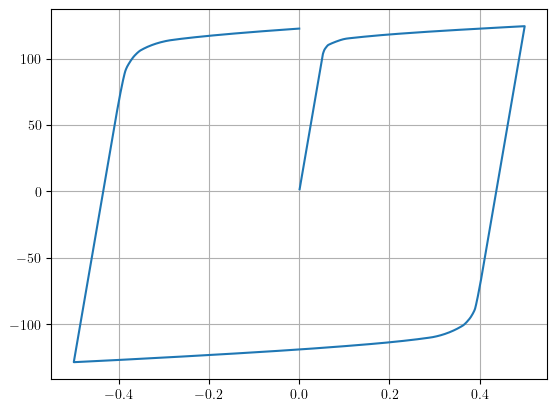
Plot the results:
fig, ax = plt.subplots()
ax.plot(uz, P)


ax.grid(True);
References#
C. M. Perez, “Nonlinear modeling of frame members for rapid infrastructure assessment,” Ph.D., University of California, Berkeley, Berkeley, CA, 2026. Available at: https://escholarship.org/uc/item/3zn367p3