Winkler L-Shaped Concrete Panel#
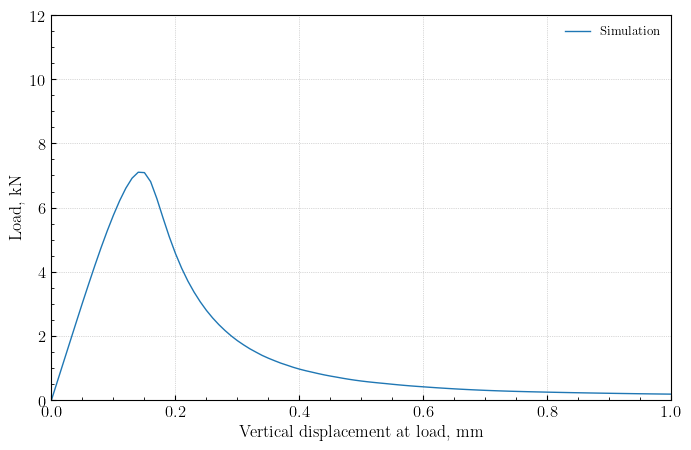
Download notebookThis simulation models the “L-shaped” plain concrete panel test as documented by Winkler et al. (2004).
The material parameters used are: \(E_c=25,850 \mathrm{MPa}, F_t=\) 2.7 MPa, \(G_f=0.09 \mathrm{MPa} \cdot \mathrm{mm}\) (Feist 2004).
Modeling#
from xara.units import create_units

units = create_units(length="millimeter", force="newton")
MPa = units.MPa
mm  = units.mm
N   = units.N
kN  = units.kN
mesh = dict(
  nx = 25,
  ny = 25,
)

length    = 500*mm
width     = 250*mm
thickness = 100*mm
1. Material#
import numpy as np
import xara


# Young's modulus, Poisson's ratio
Ec = 25850 * MPa
nu = 0.18
# Tensile and compressive strength
fc = 31.00 * MPa
ft =  2.70 * MPa
# Tensile and compressive fracture energy
Gt =  0.065 * N/mm
Gc = 10.80  * N/mm
# Characteristic length
Lc = width/mesh["nx"]

Ap = 1/((Gt*Ec)/(Lc*ft**2) - 0.5)

material = xara.MultiaxialMaterial("FariaPlasticDamage",
                                 E=Ec,
                                 nu=nu,
                                 Fc=fc,
                                 Ft=ft,
                                 beta=0.5,
                                 An=2,
                                 Bn=0.75,
                                 Ap=Ap
)


# material = xara.MultiaxialMaterial("LeeFenves",
#                                  E=Ec,
#                                  nu=nu,
#                                  Fc=fc,
#                                  Ft=ft,
#                                  Gc=Gc,
#                                  Gt=Gt,
#                                  Lc=width/mesh["nx"],
#                                  Lt=width/mesh["nx"],
#                                 #  Ftype="DP",
#                                 #  Dt=0.51,
#                                  aC=4.0,
#                                 #  Dc=0.45,
#                                 #  alphap=0.2,
#                                 )


print(material.asdict())
{'name': 1, 'type': 'FariaPlasticDamage', 'E': 25850, 'nu': 0.18, 'Ft': 2.7, 'Fc': 31, 'beta': 0.5, 'Ap': 0.0443485, 'An': 2, 'Bn': 0.75, 'density': 0}
2. Section: Plane Stress#
section = xara.PlaneSection("PlaneStress", material, thickness)
3. Geometry#
model = xara.Model(ndm=2, ndf=2)

model.material(material)
model.section(section)

model.surface((mesh["nx"], 2*mesh["ny"]),
    element="quad",
    args={"section": section},
    points={
        1: (width,  0),
        2: (length, 0),
        3: (length, length),
        4: (width,  length)
    }
)

model.surface((mesh["nx"], mesh["ny"]),
    element="quad",
    args={"section": section},
    points={
        1: (0,     width),
        2: (width, width),
        3: (width, length),
        4: (0,     length)
    }
)


import veux
veux.render(model)
The panel is fixed at the bottom and subjected to a concentrated load.
from xara.helpers import find_nodes

for node in find_nodes(model, y=0):
    model.fix(node, (1, 1))
Loading#
# Load is applied 30 mm from the free end of the horizontal leg; use the closest node
load_node = min(find_nodes(model, y=width),
                key=lambda node: abs(model.nodeCoord(node)[0] - 30*mm))

pattern = xara.StaticPattern(
    xara.NodalValue(model, load_node, 2, 1.0*mm)
)
model.pattern(pattern)
1
Analysis#
step = 0.01

analysis = xara.StaticAnalysis(model,
                               system="Umfpack02",
                               algorithm=("NewtonLineSearch", 0.6),
                               constraints="Transformation",
                               test=("Energy", 1e-12, 50, 0),
                               integrator=("LoadControl", step))

u = [0.0]
F = [0.0]
for i in range(int(1.0/step)):
    try:
        analysis.analyze(1)
    except RuntimeError:
        print(f"Analysis failed at step {i+1} of {int(1.0/step)}")
        break

    model.reactions()
    u.append(model.nodeDisp(load_node, 2))
    F.append(model.nodeReaction(load_node, 2))
Results#
import matplotlib.pyplot as plt

fig, ax = plt.subplots(figsize=(8, 5))
ax.plot(np.array(u)/mm, np.array(F)/kN, label="Simulation")
ax.set_xlim(0,  1.0)
ax.set_ylim(0, 12.0)
ax.set_xlabel("Vertical displacement at load, mm")
ax.set_ylabel("Load, kN")
ax.grid(True)
ax.legend()
<matplotlib.legend.Legend at 0x16801ff50>
References#
B. Winkler, G. Hofstetter, and H. Lehar, “Application of a constitutive model for concrete to the analysis of a precast segmental tunnel lining,” Num Anal Meth Geomechanics, vol. 28, no. 7–8, pp. 797–819, Jun. 2004, doi: 10.1002/nag.362.
Y. Zhan, “Multilevel Modeling of Fiber-Reinforced Concrete and Application to Numerical Simulations of Tunnel Lining Segments,” 2016.